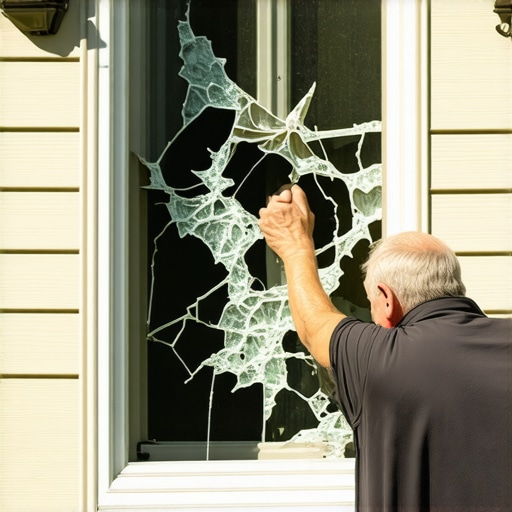
The Sudden Percussion of a Thermal Failure
That unmistakable sound of a baseball meeting an Insulated Glass Unit (IGU) is more than just a property damage report; it is an immediate compromise of your home’s thermal envelope. When a rogue projectile penetrates a double-pane window, you aren’t just looking at a hole in the glass. You are witnessing the instantaneous evacuation of argon gas and the total failure of a pressurized system designed to manage the dew point within your rough opening. As a master glazier with a quarter-century in the field, I have seen homeowners try to ‘band-aid’ these breaks with clear packing tape or silicone smear jobs. These are futile gestures. A shattered IGU is a dead IGU.
The Condensation Crisis: A Real-World Warning
I recall a homeowner in a frigid suburb who called me in a panic because their new windows were ‘sweating’ and eventually icing over on the interior after a minor crack from a bird strike. I walked in with my hygrometer and showed them that the humidity was 60 percent, but the shattered seal had allowed the internal desiccant to become fully saturated. It wasn’t just a window repair issue; it was a physics problem. The broken seal had turned the window into a thermal bridge, drawing heat out of the room so fast that the interior glass surface temperature dropped below the dew point. They thought they could wait until spring, but by then, the sash was already showing signs of black mold growth due to the constant moisture. This is why immediate action is not optional.
“Installation is just as critical as the window performance itself. A high-performance window installed poorly will fail.” AAMA Installation Masters Guide
The Anatomy of an IGU Failure
To understand why you must replace windows or at least the entire glass unit after a break, you have to understand the manufacturing science. A double-pane window consists of two lites of glass separated by a spacer bar. This spacer is filled with desiccant beads designed to suck up every molecule of moisture. When the baseball shatters the outer or inner pane, the seal is breached. The noble gas (usually argon) that provides your R-value escapes, replaced by moisture-laden ambient air. This air carries water vapor that will eventually condense between the panes, creating a permanent fog that no window cleaner can ever reach. In cold climates, this loss of the gas fill causes your U-Factor to skyrocket. Your furnace will work harder to fight the radiant cold pouring through that single remaining pane of glass.
Phase 1: Immediate Stabilization and Safety
First, don your heavy-duty gloves. Do not attempt to remove shards with bare hands. Modern windows often use annealed glass which breaks into razor-sharp daggers, unlike the tempered safety glass found in doors or bathrooms. If the glass is still in the sash, use high-quality duct tape to create a ‘web’ across the cracks. This prevents shards from falling out while you coordinate a window repair. If the hole is large, you must board it up from the exterior to protect the sill pan and interior finishes from rain. Water infiltration through a broken window is the leading cause of frame rot. If water gets behind the flashing tape because the glazing bead is compromised, you are looking at a multi-thousand dollar structural repair rather than a simple glass swap.
Phase 2: Decoding the NFRC Label and Glass Selection
When you call for a replacement, don’t just ask for ‘glass.’ You need to match the performance profile of your existing units. In northern climates, we prioritize a low U-Factor. You want the Low-E coating on Surface #3. Why? Because Surface #3 faces the interior air gap and is designed to reflect long-wave infrared radiation back into your living room. If the glazier installs a unit with the coating on Surface #2 (which is meant for hot southern climates to reflect solar heat outward), your room will feel noticeably colder in January. Demand to see the NFRC ratings. A difference of 0.05 in U-Factor might seem small, but across a 2000-square-foot home, it is the difference between comfort and a constant draft.
“The selection of glass type and its thermal properties must be matched to the specific climate zone to ensure the long-term integrity of the building envelope.” ASTM E2112 Standard Practice
The Repair vs. Replacement Dilemma
Is it possible to perform a simple glass-only window repair? Yes, if the frame is a high-quality material like fiberglass or thermally broken aluminum. However, if the rogue baseball hit a 20-year-old vinyl frame that has become brittle from UV exposure, the act of popping the glazing bead to remove the old glass might crack the frame itself. Vinyl expands and contracts significantly; over time, the weld points in the corners can fail. If I see ‘smiling’ sills or corner gaps, I tell the homeowner it is time to replace windows entirely. Installing a brand-new, high-tech IGU into a failing, drafty frame is like putting a Ferrari engine in a rusted-out tractor. You aren’t getting the performance you paid for.
Technical Specifications: Spacers and Sealants
When ordering your replacement, ask about the spacer tech. Avoid old-school aluminum spacers which act as a cold-conduit. Look for ‘warm-edge’ spacers made of foam or structural plastic. These prevent the perimeter of the glass from getting cold enough to reach the dew point. Furthermore, ensure the glazier uses a high-grade primary seal of polyisobutylene (PIB) and a secondary seal of silicone or polysulfide. This dual-seal system is what keeps the argon gas inside for 20 years instead of five. If the weep hole in the bottom of the frame is clogged, the new seal will sit in standing water and fail prematurely. A true professional will clear those channels before the new glass goes in.
Conclusion: Managing the Rough Opening
A broken window is an emergency because it turns your home into an open system. Whether you are dealing with a rogue baseball or a thermal stress crack, the goal is to restore the hermetic integrity of the wall. Don’t let a ‘caulk-and-walk’ contractor convince you that a bead of clear silicone is a fix. Measure the rough opening, check your shims for level, and ensure your flashing is directed outward. Proper window science is the only thing standing between you and a skyrocketing energy bill. Treat the glass as a precision-engineered component, and your home will reward you with decades of quiet, dry, and efficient performance.