The Invisible Grime: Why Pollen Is the Glazier’s Springtime Nemesis
As someone who has spent over two and a half decades examining the structural integrity of fenestration systems, I can tell you that the yellow dust coating your windows every spring is more than just an aesthetic nuisance. It is a biological particulate that can compromise the mechanical function of your operable units. When homeowners ask about the easy way to clean pollen off your screens without a hose, they are usually trying to avoid a mess. But as a master glazier, I see it differently. I see the protection of the glazing bead and the prevention of moisture accumulation in the rough opening.
“Installation is just as critical as the window performance itself. A high-performance window installed poorly will fail.” – AAMA Installation Masters Guide
I recall a specific instance a few years back during a consultation in a high-pollen region of the South. A homeowner called me in a panic because their new windows were ‘sweating’ and the screens looked like they were covered in felt. I walked in with my hygrometer and showed them the humidity was 60 percent. It wasn’t the windows; it was their lifestyle and the fact that their clogged screens were preventing proper pressure equalization and airflow. The pollen had created a literal blanket, trapping moisture against the sash. It was a maintenance crisis disguised as a product failure.
The Physics of Pollen Adhesion on Mesh
Pollen grains are not just round balls; they are often spiked or coated in sticky lipids designed to cling to surfaces. When these grains encounter a fiberglass or aluminum screen, they don’t just sit there. They wedge themselves into the intersections of the weave. If you live in a climate with high humidity, this pollen can hydrate, expand, and then dry into a cement-like crust. If you are in a Southern climate where the Solar Heat Gain Coefficient (SHGC) is your primary concern, that layer of pollen actually absorbs radiant heat, increasing the temperature of the air buffer between the screen and the glass. For optimal performance, you want your Low-E coating on Surface #2 to reflect heat, but a dirty screen creates a heat trap that works against your glass technology.
Why the Hose Isn’t Always Your Friend
Many people reach for the garden hose immediately. In my professional opinion, this is often a mistake. High-pressure water can force particulates into the weep holes of the window frame. These small drainage paths are designed to let water out of the sill pan area. When they get clogged with a slurry of pollen and water, you end up with standing water inside the frame profile. This is how window repair calls start. The water eventually finds a path to the flashing tape or the wooden framing of the house, leading to rot that remains hidden for years.
The Dry-Cleaning Method: A Technical Breakdown
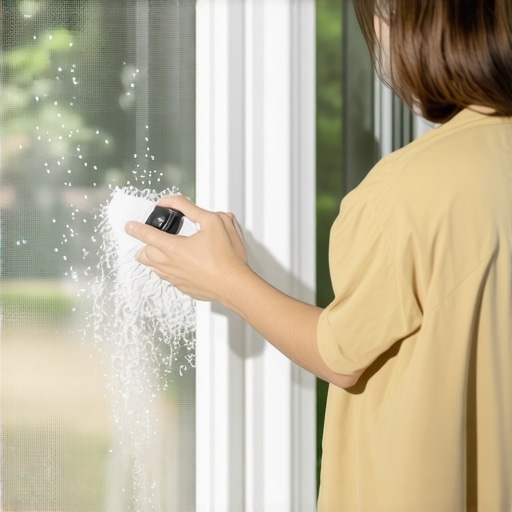
The most effective way to handle this without water is to utilize the principles of static electricity and mechanical agitation. First, you must address the screen while it is still in the frame if possible, or carefully remove it by releasing the spring clips. Do not bend the frame; most residential screens use roll-form aluminum which has a memory. Once bent, it will never sit tight against the muntins or the frame again, creating gaps for insects. [image placeholder]
Use a high-quality vacuum with a soft-bristle brush attachment. You must move vertically, following the line of the sash. This removes the loose, ‘dry’ pollen before it has a chance to become a paste. For the stubborn, electrostatic-ally charged particles, a lint roller is an surprisingly effective tool for a window cleaner. The adhesive on the roller is often stronger than the bond between the pollen and the fiberglass mesh. This technique ensures you aren’t pushing the dirt through the screen and onto the glass surface.
When Maintenance Reveals a Need for Window Repair
While cleaning, you should perform a structural audit. Check the glazing bead—the strip of vinyl or aluminum that holds the glass in the sash. If it is brittle or cracking, cleaning the screen won’t save you from a future seal failure. If you notice the screen mesh is sagging or pulling away from the spline (the rubber cord holding the mesh in the groove), it is time to consider if you should replace windows or at least the screen components. A screen that does not maintain tension is a sign of UV degradation.
“The NFRC label provides a reliable way to determine if a window will truly perform in its specific climate zone, regardless of marketing claims.” – NFRC Performance Standards
In hot Southern climates, the enemy is the sun. If your screens are constantly caked in pollen and your energy bills are rising, you might be dealing with an outdated SHGC rating. Modern windows in the South should focus on blocking the sun’s heat before it even touches the glass. Tinting and thermally broken frames are essential. If your current frames are conductive aluminum without a thermal break, no amount of cleaning will fix the radiant heat transfer occurring at the rough opening.
The Glazier’s Final Word on Screen Care
Don’t fall for the ‘caulk-and-walk’ mentality of cheap maintenance. Cleaning your screens is about preserving the entire window system. By using dry methods—vacuuming and microfiber agitation—you protect the weep holes and ensure that the operable parts of your home continue to breathe. If you find that the frames are pitted or the glass is permanently etched from acidic pollen residue, it is a clear indicator that the window’s service life is ending. Real energy savings and home comfort come from a clean, well-maintained system where every component, from the shim to the screen, is doing its job perfectly.
{“@context”:”https://schema.org”,”@type”:”HowTo”,”name”:”How to Clean Pollen Off Window Screens Without a Hose”,”step”:[{“@type”:”HowToStep”,”text”:”Vacuum the screen using a soft-bristle brush attachment in vertical strokes.”},{“@type”:”HowToStep”,”text”:”Use a lint roller to pick up remaining electrostatic-ally charged pollen grains.”},{“@type”:”HowToStep”,”text”:”Wipe the frame and sash with a dry microfiber cloth to remove settled dust.”},{“@type”:”HowToStep”,”text”:”Inspect the weep holes for clogs and clear them with a small wire if necessary.”}]}