Beyond Ammonia: The Master Glazier’s Guide to Eco-Friendly Window Care and Performance
I once walked into a home in the dead of a Minnesota winter where the owner was convinced their three-year-old casement windows were defective. They were sweating profusely: water was literally pooling on the wood sills. The owner was ready to replace windows that had cost them a small fortune just a few years prior. I pulled out my hygrometer and found the interior humidity at a staggering sixty-two percent. It was a cold February morning, and the dew point on the interior glass surface had been reached because the family was boiling large pots of water for a party without using their range hood. It was not a product failure: it was a physics failure. The homeowner had been using heavy ammonia-based sprays to wipe down the condensation, unknowingly accelerating the degradation of the glazing bead and the secondary seals of the insulated glass units (IGUs). This is the reality of window maintenance that most caulk-and-walk contractors never tell you: what you put on your glass matters as much as how the window was installed.
“Installation is just as critical as the window performance itself. A high-performance window installed poorly will fail.” – AAMA Installation Masters Guide
The Chemical Conflict: Why Ammonia is a Glazier’s Nightmare
Most people reach for a blue bottle of window cleaner without realizing they are spraying a harsh solvent onto a complex mechanical system. Ammonia is excellent at cutting grease, but it is a disaster for the materials that hold your window together. Modern windows rely on EPDM gaskets, silicone sealants, and vinyl (PVC) frames. Ammonia is known to dry out these materials, leading to embrittlement over time. When a glazing bead becomes brittle, it loses its ability to hold the glass firmly against the sash, which leads to air infiltration and, eventually, water bypass. [image_placeholder_1]
Furthermore, if you have a window that needs a window repair because of a failed seal, ammonia might be the culprit. The primary seal in an IGU is typically polyisobutylene (PIB). While it is tucked away, aggressive cleaning can lead to chemical migration if the glazing bead is compromised. An eco-friendly alternative isn’t just about saving the planet: it is about saving the structural integrity of your rough opening and the glass within it. When you use a natural acid like white vinegar, you are achieving a clean surface without the risk of solvent-based degradation of the architectural polymers.
The Glass Class: Understanding Your High-Performance Glazing
In a cold climate, the window is the weakest link in your thermal envelope. We focus heavily on the U-Factor. The U-Factor measures the rate of heat loss: the lower the number, the better the window is at keeping heat inside. When we talk about replace windows projects, I always point homeowners to the NFRC label. You want to see a low U-Factor and a high Visible Transmittance (VT) to allow natural light to offset your heating bills. This is why cleaning is so vital: a dirty window reduces VT and changes the thermal profile of the exterior pane.
“The NFRC provides a fair, accurate, and credible rating system for the energy performance of windows, doors, and skylights.” – National Fenestration Rating Council (NFRC)
To achieve these numbers, manufacturers use Low-E (low-emissivity) coatings. In northern climates, this coating is typically applied to Surface #3 (the exterior face of the interior pane). This reflects the long-wave infrared radiation (heat from your furnace) back into the room. If you use abrasive or highly alkaline cleaners like ammonia, and you happen to have an older window with an exposed coating or a poorly sealed edge, you risk oxidizing that silver-based layer. An eco-friendly solution using distilled water and white vinegar is much gentler on these microscopic metallic layers. This preserves the emissivity properties for decades rather than years.
The Master Glazier’s Eco-Friendly Recipe
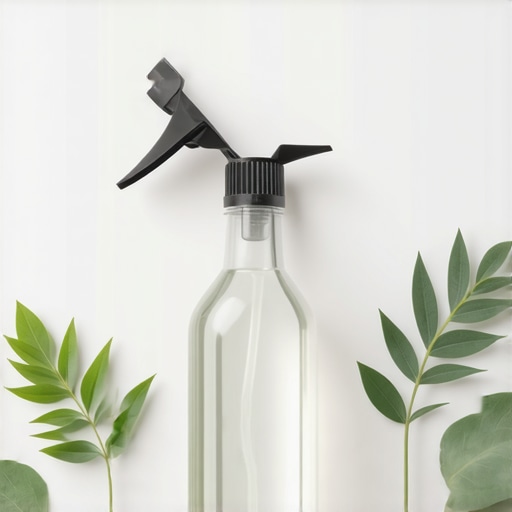
The best window cleaner I have ever used in my twenty-five years doesn’t come from a chemical plant. It’s a simple mixture: fifty percent distilled water and fifty percent white vinegar. Why distilled? Because tap water contains minerals like calcium and magnesium that leave ghosting or streaks on the glass. The acetic acid in the vinegar is just strong enough to dissolve bird droppings and pollen without reacting with the sash material or the muntin bars. For windows that are particularly stubborn, I add a tablespoon of cornstarch to the liter of solution. The cornstarch acts as a microscopic abrasive that polishes the glass without scratching it. When you wipe it off with a high-quality microfiber cloth, you are left with a surface that is chemically neutral. This prevents the static cling that ammonia-based cleaners often create, which actually attracts dust back to the window faster.
The Science of Maintenance and Longevity
Maintenance is not just about aesthetics. A clean window allows you to inspect the weep hole system. If you look at the bottom of your window frame, you will see small slots. These are designed to allow water that bypasses the glazing bead to exit the frame and drain out onto the sill pan. If these are clogged with dirt or the residue of soapy cleaners, water will back up. I have seen rough opening headers completely rotted out because a homeowner let their weep holes clog, and the water found a path into the wall cavity instead of the outdoors. When you are cleaning, pay attention to the shim areas if they are visible during a window repair or inspection. If you see signs of movement or if the operable sash is dragging, cleaning the glass is only a temporary fix. You need to ensure the window is square, level, and plumb. A high-performance window that is out of square will put uneven pressure on the IGU, leading to a stress crack or seal failure regardless of how eco-friendly your cleaner is.
Thermal Performance: Why Clean Glass Matters
It sounds like a small detail, but the cleanliness of your glass affects the Solar Heat Gain Coefficient (SHGC). In the winter, you want that solar gain to help heat your home. A layer of grime can reduce the Visible Transmittance (VT) and interfere with the way the Low-E coating manages radiant heat. By using a vinegar-based solution, you ensure there is no film left behind. Ammonia and synthetic detergents often leave a surfactant film that can actually trap heat on the glass surface, increasing the thermal stress on the pane. In twenty-five years, I have seen it all: from houses where the flashing tape was installed backward to luxury condos where the muntin bars were falling off because of cheap adhesive. The one constant is that homeowners who treat their windows as part of a technical system: using the right chemistry for cleaning and the right physics for climate control: always have fewer issues with rot and seal failure. If your windows are more than twenty years old and you find yourself constantly reaching for the window cleaner just to see through the fog between the panes, it is time to stop repairing and start looking at high-performance replacements with warm-edge spacers and argon gas fills. The density of Argon gas is much higher than air, which slows down the convection currents within the glass unit, significantly lowering the U-Factor. This tech only works if the seals remain intact, and keeping chemicals like ammonia away from those seals is your first line of defense.