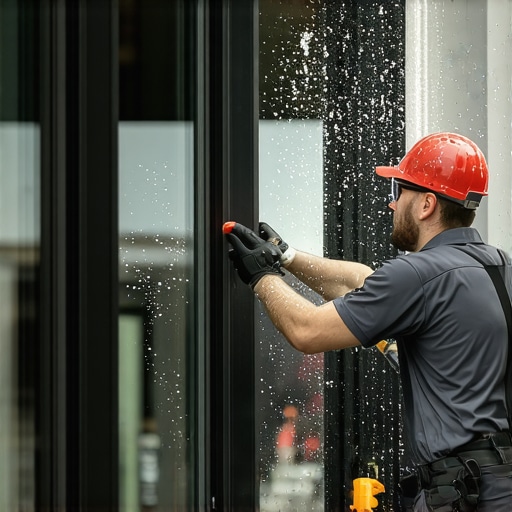
The Molecular Siege: Why Hard Water Is the Glazier’s Nemesis
In my twenty-five years as a master glazier, I have seen buildings that were architectural masterpieces rendered look like neglected ruins simply because of a failure to understand the chemistry of the glass surface. Glass is not the inert, impenetrable barrier most facility managers believe it to be. On a microscopic level, glass is a porous, hydrophilic surface. When we talk about managing hard water buildup on commercial office windows, we are not just talking about aesthetics: we are talking about preventing the permanent chemical alteration of the silica structure itself. A window cleaner can handle dust and pollen, but when calcium carbonate and magnesium salts begin to bond to the glass, you are no longer cleaning; you are performing a chemical intervention.
The Narrative: The Condensation and Mineral Crisis
A property manager for a Class A office tower called me in a panic because their brand-new, high-performance curtain wall looked like it was covered in a permanent fog. They had hired three different window cleaning crews, and the glass still looked etched. I walked onto the site with my hygrometer and a 10x loupe. I showed them that the mineral deposits were not on the interior from humidity, but were the result of a malfunctioning rooftop cooling tower that was misting the north facade with mineral-heavy water. Every time the sun hit that glass, the Solar Heat Gain would bake those minerals into the surface. It was not a product failure: it was a maintenance failure. I had to explain that if they did not adjust their mechanical systems, they would be looking at a total window repair project involving mechanical polishing, or worse, a full-scale effort to replace windows that were less than two years old.
“The cleaning and maintenance of architectural glass are essential to the long-term performance and aesthetic integrity of the building envelope.” – AAMA 610-15: Voluntary Specification for Cleaning and Maintenance
Understanding Stage 1 vs. Stage 2 Corrosion
We categorize hard water damage into two distinct phases. Stage 1 is accretion. This is when the minerals like calcium and magnesium sit on the surface of the glass. At this stage, the bond is mechanical. A professional window cleaner using an acidic solution or a mild abrasive can usually lift these deposits without damaging the glass. However, if these deposits are left to sit, especially on windows with a high Solar Heat Gain Coefficient in hot climates, they undergo a chemical transition. The heat acts as a catalyst, and the minerals begin to leach the silicates out of the glass. This is Stage 2: etching. At this point, the glass surface is physically altered. The smooth plane of the glass now has microscopic pits. This is why window repair becomes so costly: you have to mechanically grind the glass down using cerium oxide to reach a fresh, smooth layer of silica.
The Impact of Frame Design and Weep Holes
The management of water does not stop at the glass surface. In a commercial setting, the window frame, whether it is a storefront system or a curtain wall, is designed to manage water through an internal drainage system. Every professional glazier knows that the weep hole is the most critical part of the assembly. When hard water runoff flows down the glass, it carries those minerals into the glazing bead and down into the sill pan. If those minerals calcify inside the weep holes, the system fails. Water backs up, the pressure increases, and eventually, that water finds its way into the rough opening. I have seen entire steel headers rotted out because of clogged weep holes. Proper maintenance must include flushing these drainage paths to ensure that the water has a clear exit strategy.
“Water penetration through the window assembly can result in damage to the building’s structural components and interior finishes.” – ASTM E2112-19
The Physics of the South-Facing Facade
In hotter climates, such as those found in Texas or Arizona, the enemy is not just the water, but the sun. Low-E coatings are typically placed on Surface #2 of a double-pane unit to reflect infrared radiation before it enters the building. However, this means the exterior pane of glass absorbs a significant amount of heat. When a stray sprinkler or a poorly executed window cleaning leaves hard water on a surface that is 140 degrees Fahrenheit, the evaporation happens almost instantly. This leaves behind a concentrated mineral crust. This is why I always tell installers and maintenance crews to never clean glass in direct sunlight. The thermal stress combined with the rapid mineral deposition can lead to permanent damage that no window cleaner can fix.
When to Repair and When to Replace Windows
There comes a point where the cost of restoration exceeds the cost of replacement. If a commercial window has deep Stage 2 etching across more than 30 percent of its surface, the labor required to polish that glass back to its original optical clarity is immense. Furthermore, aggressive polishing can create lenses in the glass, leading to visual distortion that is unacceptable in an office environment. In these cases, it is more cost-effective to replace windows entirely. When we do this, we often recommend upgrading to a glass with a factory-applied hydrophobic coating. These coatings fill the microscopic pores of the glass, making it much harder for minerals to find a foothold. It is a more expensive upfront cost, but it eliminates the need for the frequent, aggressive window repair cycles that plague untreated glass in hard water areas.
The Installation Factor: Flashing and Sealants
Even the best glass will fail if the installation is flawed. During a window repair or replacement, I look closely at the flashing tape and the sealant joints. Hard water deposits can also affect the adhesion of silicone sealants. If the minerals are allowed to build up at the interface between the glass and the glazing bead, they can create a capillary path for water to bypass the gaskets. This is why I am so intolerant of installers who rely on a bead of caulk to hide a poorly fitted sash. A proper glazier ensures that the rough opening is flashed correctly and that the sill pan is sloped toward the exterior. We manage the water: we do not just try to block it out. The goal is a continuous water barrier that directs every drop away from the building’s structural core.