The Invisible Engineering of Modern Windows
In my 25 years in the glazing trade, I have seen the evolution of the residential window from a simple sheet of clear float glass into a complex thermal machine. I remember a specific call from a homeowner in a high-humidity suburb. They called me in a panic because their brand-new, high-efficiency windows were sweating profusely. I walked into the living room with my hygrometer and showed them that their indoor humidity was hovering at 60 percent. It was not a window failure; it was a ventilation issue. However, the real tragedy was revealed when the sun hit the glass at an angle. To get rid of what they thought was adhesive residue, the homeowner had taken a standard metal razor blade to the surface. In the light, the glass looked like a topographical map of scratches. This is why understanding the physical properties of your glazing is non-negotiable for anyone involved in window cleaning or window repair.
“Installation is just as critical as the window performance itself. A high-performance window installed poorly will fail.” AAMA Installation Masters Guide
The Anatomy of Sputtered Coatings
To understand why a metal blade is the enemy of modern glass, we must look at the molecular level. High-performance units utilize what we call soft-coat Low-E (low-emissivity) coatings. Unlike the older hard-coat pyrolytic glass where the coating is baked into the glass while it is still molten, soft-coat Low-E is applied via a process called MSVD (Magnetron Sputter Vacuum Deposition). This involves depositing thin layers of silver, zinc oxide, or titanium between dielectric layers. These layers are designed to manage long-wave infrared radiation. In a cold climate, these coatings reflect heat back into the room to maintain a low U-Factor. In hotter regions, the coating is often placed on Surface #2 of the Insulated Glass Unit (IGU) to reflect solar heat gain before it even enters the home. When you use a metal scraper, you are not just cleaning a surface; you are potentially micro-pitting these delicate metallic layers if the coating is exposed or if the blade catches a microscopic piece of fabricating debris known as glass fines. These fines are tiny particles of glass that become fused to the surface during the tempering process. A metal blade can break these loose and drag them across the pane, creating a permanent scar.
Why Plastic is the Professional Choice
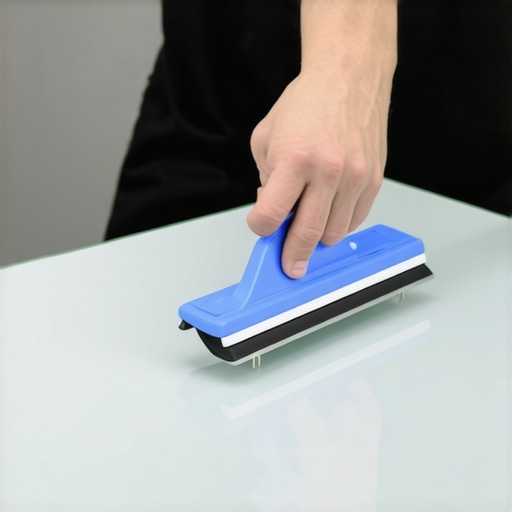
A professional window cleaner knows that the hardness of the tool must be calibrated to the surface being cleaned. On the Mohs scale of mineral hardness, standard window glass sits around a 5.5 to 6. A carbon steel razor blade is often significantly harder. Using a plastic scraper, specifically one made of high-density polycarbonate, provides enough mechanical leverage to remove organic debris like bird droppings or paint overspray without exceeding the pressure threshold that leads to scratching. This is especially vital when dealing with high-performance glass that has undergone heat-strengthening. When you replace windows, you are investing in an optical-grade product. Treating it like a piece of structural steel is a recipe for a costly window repair that usually ends in a full IGU replacement. Plastic scrapers flex and conform to the slight undulations of the glass surface, whereas a rigid metal blade concentrates all the force on a single microscopic point. If that point hits a glass fine or a piece of architectural grit, it will gouge the surface.
“The thermal performance of a fenestration product is dependent on the integrity of the glass surfaces and the maintenance of the gas-fill environment.” NFRC Performance Standards
Thermal Stress and Surface Integrity
We also have to consider the thermal physics of the sash and the glass it holds. A window is an operable system that experiences significant thermal expansion and contraction. When a surface is scratched by improper cleaning tools, it creates a point of concentrated stress. High-performance glass is often under significant internal tension due to the Argon or Krypton gas fills and the thermal gradients between the interior and exterior panes. A deep scratch can become the starting point for a stress crack, especially during a cold snap where the center-of-glass temperature drops rapidly compared to the edge-of-glass temperature near the spacers. When I evaluate a rough opening for a new installation, I look at the shim placement to ensure there is no binding, but all that precision is wasted if the homeowner compromises the glass integrity with a five-cent razor blade. If you are performing a window repair and find that the glazing bead is tight but the glass is failing, look for those telltale fine-line scratches from a previous cleaning attempt.
The Correct Cleaning Protocol
Instead of reaching for the metal, start with a high-quality surfactant. The goal of a window cleaner should be to suspend the debris in a liquid film before any mechanical force is applied. If a stubborn spot remains, a plastic scraper used with a generous amount of lubricant is the only safe path. This preserves the SHGC (Solar Heat Gain Coefficient) and the VT (Visible Transmittance) of the unit. If you find yourself in a position where you must replace windows because of surface damage, ensure the new units come with a factory-applied protective film. This film should stay on through the construction phase, protecting the glass from mortar, stucco, and the inevitable “caulk-and-walk” installer who might get silicone on the glass. Water management is a science, and so is glass maintenance. Using a sill pan and proper flashing tape ensures the wall stays dry, but using a plastic scraper ensures the glass stays clear. Always remember that once the surface of a high-performance coating is compromised, the thermal efficiency begins to degrade as the metallic layers oxidize. Protect your investment by treating the glass as the precision-engineered component that it is.