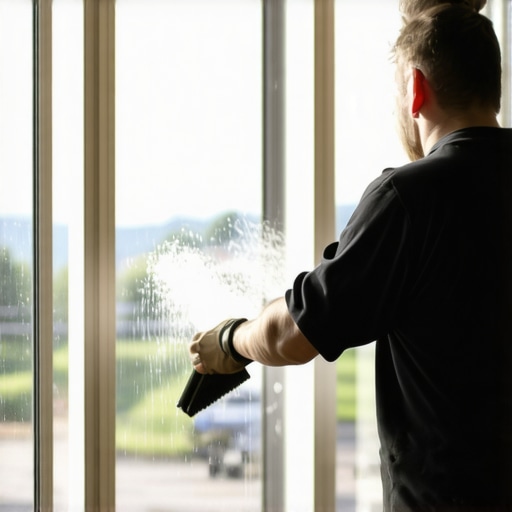
The Science of Clarity: Why Professionals Avoid Chemicals
Most homeowners reach for a blue spray bottle and a roll of paper towels when they see a smudge on their glass. As a glazier with over 25 years in the trade, I can tell you that this is the first step toward ruining your Insulating Glass Units (IGUs). The residue left behind by commercial surfactants acts as a magnet for dust and environmental pollutants. When we talk about professional window cleaning, we are not just talking about aesthetics; we are talking about maintaining the structural integrity of the glazing bead and the weatherstripping. I once walked into a home where the homeowner complained about a persistent ‘fog’ on her triple-pane units. I pulled out my hygrometer and saw the indoor humidity was spiking at 65 percent in the dead of a Minnesota winter. It wasn’t the window cleaner that was the problem; it was the fact that her ‘clean’ windows were actually showing the first signs of seal failure because the chemicals had slowly degraded the secondary sealant of the IGU. If you want a streak-free finish that lasts, you must understand the physics of water and the surface tension of the glass itself.
“Installation is just as critical as the window performance itself. A high-performance window installed poorly will fail.” AAMA Installation Masters Guide
The Physics of Pure Water and Glass Surface Tension
Glass is not as smooth as it feels to your fingertip. Under a microscope, it is a jagged landscape of peaks and valleys. When you use tap water, you are filling those valleys with calcium, magnesium, and silica. This is known as Total Dissolved Solids (TDS). To clean like a pro, you need water with a TDS count of zero. This is ‘hungry’ water. Because the water is deionized, it aggressively seeks out minerals and dirt to bond with, lifting them off the sash and glass surface without the need for soap. This is particularly vital in Northern climates where the U-Factor is the primary metric of concern. A clean window allows for maximum Visible Transmittance (VT), which is the amount of light that enters the space. When you have a Low-E coating on Surface 3 to reflect heat back into your home during a cold January, any buildup on the glass can interfere with the thermal performance of the unit. We refer to this as maintaining the ‘optical purity’ of the aperture.
Identifying When You Need Window Repair During Cleaning
Cleaning is the best time to perform a diagnostic check on your rough opening. As you move your squeegee across the pane, listen for the sound of the glass. A rattling noise indicates that the glazing bead has become brittle or has shrunk, which is a common issue with low-grade vinyl windows. This is where window repair becomes necessary. Look closely at the corners of the frame. Are the mitered joints tight? If you see gaps, you are looking at a path for air infiltration. In my career, I have seen thousands of ‘caulk-and-walk’ jobs where the installer relied on a bead of silicone rather than proper flashing tape. If you find water sitting in the sill pan after a light cleaning, your weep holes are likely clogged. These small exits are designed to allow water that bypasses the primary seals to exit the frame. If they are blocked, that water will eventually find its way into your subfloor, leading to rot that can cost thousands to fix. This is why a simple cleaning session often leads to the realization that it is time to replace windows entirely, especially if the thermal spacers have started to shimmy out of place.
“The flashing system must be integrated with the water-resistive barrier in a manner that directs water to the exterior.” ASTM E2112
The Professional Toolset: Beyond the Squeegee
To execute a professional clean with only water, you need the right hardware. Forget the ladder and the bucket for a moment and consider the water-fed pole system. This uses a telescopic carbon fiber pole and a specialized brush. The brush agitates the dirt, and the constant flow of deionized water rinses it away. But for the interior, we use a different approach. You need a high-quality squeegee with a brass or stainless steel channel and premium rubber. The rubber must be changed frequently; a single nick in the blade will leave a line of water that turns into a streak. When you are cleaning the sash, pay attention to the muntins if you have a colonial grid pattern. These are often the areas where dirt accumulates. If your windows are older wood units, be extremely careful with water volume. Excess moisture can penetrate the wood grain if the paint film is compromised, leading to expansion that makes the windows difficult to operate. A professional window cleaner knows that the goal is to manage the moisture, not just douse the glass.
Climate-Specific Maintenance: The Northern Perspective
In regions like Chicago or Minneapolis, the primary enemy is the dew point. When the temperature outside drops to sub-zero levels, the internal surface of your glass stays much colder than the room air. This is where U-Factor becomes king. A lower U-Factor means the window is a better insulator. If you are cleaning your windows and notice condensation between the panes, the desiccant in the spacer bar is saturated. No amount of cleaning will fix this; it is a sign of a breached seal. At this point, the Argon or Krypton gas fill has leaked out, and the window has lost a significant portion of its R-value. This is a common trigger for a window repair specialist to suggest a full IGU replacement. Furthermore, in these cold climates, we always look for ‘warm-edge’ spacers. These are made of structural foam or composite materials rather than aluminum. Aluminum is a conductor, and it will pull heat away from the edge of the glass, creating a cold spot where condensation forms. If you see black mold on the interior glazing bead, your window is failing the thermal test.
How to Clean Your Windows: A Step-by-Step Technical Protocol
- Deionize Your Water: Use a portable DI resin filter to strip minerals from your tap water. Check the TDS with a digital meter; it must read 000 ppm.
- Frame Inspection: Before applying water, inspect the sill pan and weep holes. Remove any debris like dead insects or leaf litter that could block drainage.
- Surface Agitation: Use a microfiber washer sleeve to apply the pure water to the glass. Work in a circular motion to break the ionic bond between the dirt and the silica surface.
- The Squeegee Technique: Use the ‘fanning’ method. Start at the top corner, cutting a dry strip across the top, then move in a continuous ‘S’ pattern down the pane. Never lift the blade from the glass until you reach the bottom.
- Detailing the Edges: Use a dry, lint-free scrim cloth to wipe the very edge of the glass where it meets the glazing bead. This prevents ‘wicking,’ where water trapped in the seal slowly crawls back onto the clean glass.
When Cleaning Reveals the Need for Replacement
Sometimes, no matter how much you clean, the glass looks ‘etched’ or ‘milky.’ This is often a sign of hard water damage that has chemically bonded with the glass, or worse, it is ‘solar pumping’ damage. Solar pumping occurs when the IGU expands and contracts daily, eventually wearing out the primary seal. If you live in a high-wind area, the constant positive and negative pressure can accelerate this. When you reach the point where the hardware is sticking, the frames are bowed, or the glass is permanently clouded, it is time to replace windows. Don’t fall for the cheap ‘insert’ or ‘pocket’ replacements unless your existing frames are structurally sound and perfectly square. A full-frame replacement is the only way to ensure the rough opening is properly flashed and insulated. It allows us to inspect the shim placement and ensure the header isn’t sagging. Remember, a window is a hole in your building envelope; it is the most vulnerable part of your home’s thermal defense. Treat it with the technical respect it deserves, and it will keep you dry and warm for decades.