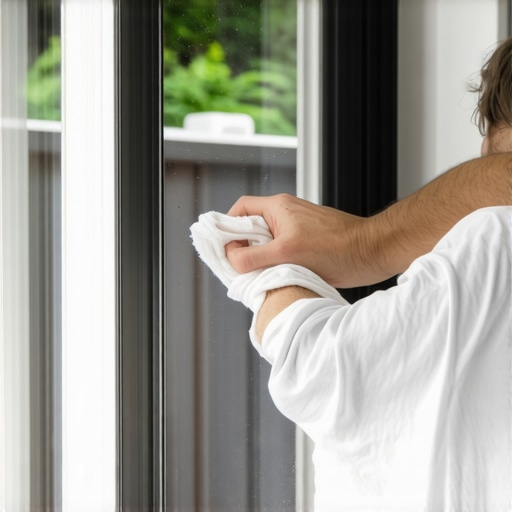
After twenty five years in the glazing industry, I have seen every possible mistake a homeowner or a ‘caulk and walk’ installer can make. People often focus on the brand of the window, but they forget that a window is a complex thermal bridge. If you cannot see through it clearly, or if the glass itself is failing due to poor maintenance or installation, the most expensive triple pane unit in the world is worthless. Recently, I have been asked why our crew completely abandoned paper towels in favor of high grade cotton rags and microfiber for cleaning. It is not just about being eco friendly. It is about the physics of the glass surface and the integrity of the glazing bead.
The Condensation Crisis: A Master Glazier Perspective
A homeowner called me in a panic because their new windows were ‘sweating.’ I walked in with my hygrometer and showed them the humidity was 60 percent. It was not the windows; it was their lifestyle. They were boiling pasta and running a humidifier in a sealed tight house in January. This story illustrates a critical point: windows are the messengers of your home’s health. When you see moisture, you think about a window cleaner, but often, you are actually looking at a failure of the home’s ventilation system or a compromised seal in the Insulated Glass Unit (IGU). If that moisture is between the panes, no amount of cleaning will help. You are looking at a window repair or a full replace windows scenario because the desiccant in the spacer bar has reached its saturation point.
The Science of the Streak: Why Paper Towels Fail
When you use a paper towel, you are essentially rubbing wood pulp and chemical binders across a microscopic landscape of peaks and valleys. Glass might look smooth, but at a high magnification, it is a porous surface. Paper towels leave behind lint and a film of wood oils that attract dust. This is why we swapped to surgical grade cotton rags. Cotton is highly absorbent and has a mechanical ‘bite’ that lifts oils without depositing debris. For a master glazier, the goal is a chemically clean surface so we can inspect the glass for ‘seeds’ or ‘bubbles’ and ensure the glazing bead is properly seated. If you use the wrong material, you are just moving dirt into the weep holes or the sash channels.
“Installation is just as critical as the window performance itself. A high-performance window installed poorly will fail.” AAMA Installation Masters Guide
The Installation Autopsy: Why Most Windows Fail
In cold climates like Minneapolis or Chicago, the enemy is heat loss and the dreaded dew point. When I perform a window repair, I often find that the rough opening was never properly flashed. Most installers rely on the nailing fin of a vinyl window as the primary water barrier. That is a recipe for rot. A proper installation requires a sill pan to direct water outward, and flashing tape integrated with the weather resistive barrier. We use shims to ensure the frame is plumb, level, and square, but if those shims are not placed correctly under the setting blocks of the glass, the weight of the IGU will cause the frame to sag, leading to air leaks that no window cleaner can fix.
Thermal Logic: U-Factor and Surface Emissivity
In the North, we prioritize the U-Factor. This is the measure of non solar heat flow. A lower U-Factor means the window stays warmer on the inside, which prevents the condensation I mentioned earlier. We use Low-E coatings specifically on Surface #3. To understand this, imagine the surfaces of a double pane window numbered from 1 to 4 starting from the outside. By putting the coating on Surface #3, we reflect the long wave infrared radiation (furnace heat) back into the room. If we were in the South, we would put that coating on Surface #2 to reject the sun’s heat before it even enters the house. This is the ‘Glazing Zooming’ that separates a pro from a salesman. You need to understand how the gas fill, usually Argon, slows down the convection currents inside the IGU to truly appreciate why replace windows projects are so technical.
“The management of water at the window-to-wall interface is the primary function of a successful installation system.” ASTM E2112
When to Repair vs. When to Replace
Many homeowners ask if they can just do a window repair on a foggy pane. The answer is usually yes, you can replace just the glass unit, but you must check the sash and the frame for structural integrity. If the muntins are internal, they are protected, but if they are external, they can trap water against the glass. If your operable windows are sticking, it might not be the hardware; it might be that the house has settled and the rough opening is now compressing the frame. In these cases, a window cleaner won’t help you, and a simple glass swap is a band aid on a broken leg. You need a full frame replacement to restore the thermal envelope of the building.