The Hidden Enemy in Your Window Tracks
Most homeowners view window cleaning as a matter of clear glass and streak-free finishes. However, as a master glazier with a quarter-century in the field, I can tell you that the real battle for your home’s efficiency is won or lost in the deep grooves of the window track. When you ignore the debris accumulating in those channels, you are inviting a mechanical failure that often leads people to prematurely replace windows when a simple window repair or maintenance routine would have sufficed. The dirt in your grooves isn’t just dust; it is an abrasive slurry of silica, organic matter, and atmospheric pollutants that acts like sandpaper against your weatherstripping every time you move the operable sash.
The Condensation Crisis: A Narrative Warning
I recall a call-out in a bitter January during a Chicago cold snap. A homeowner was convinced their high-end double-pane units were failing because the bottom of the frames was thick with ice. They were ready to spend twenty thousand dollars to replace every unit in the house. I walked in with my hygrometer and a simple putty knife. I cleared a thick layer of pet hair and dead insects from the weep holes and the sill pan. The moisture wasn’t a seal failure; it was a drainage failure. The debris had blocked the exit path for condensation, causing water to back up, freeze, and create a thermal bridge that sucked the heat right out of the room. It wasn’t the windows that were the problem; it was the lack of a maintenance protocol that respected the physics of the rough opening.
“Installation is just as critical as the window performance itself. A high-performance window installed poorly will fail, and a poorly maintained window will perform like a low-grade unit regardless of its initial cost.” – AAMA Installation Masters Guide
The Physics of the Vacuum Attachment Hack
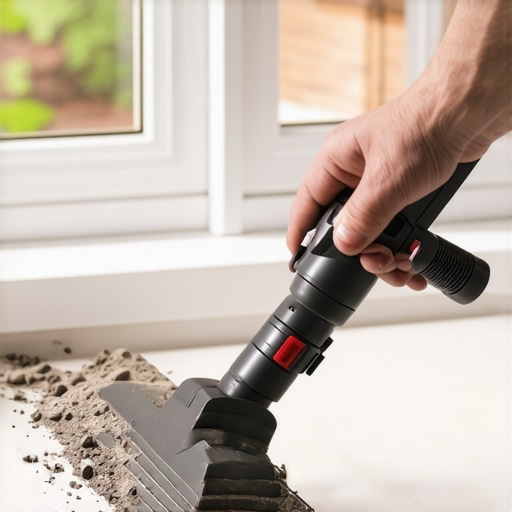
Standard vacuum nozzles are often too wide to reach the primary glazing bead area or the deep recesses where the shim might be visible if the flashing was done poorly. To truly clear these areas, you need a specialized hack. Take a cardboard toilet paper roll or a piece of flexible PVC tubing and tape it to the end of your crevice tool. Flatten the tip of the tube so it can slide into the narrowest part of the track. This increases the static pressure and airflow velocity at the tip, allowing you to extract particulate matter that a standard brush would just push deeper into the sill. Why does this matter? Because in a cold climate, every gram of dirt acts as a desiccant, holding moisture against the frame. This leads to the degradation of the flashing tape and eventual rot of the wooden buck. You aren’t just cleaning; you are managing the dew point within the frame assembly.
Understanding the Anatomy of the Track
When we discuss a window cleaner routine, we must talk about the glazing bead and the sash balance. In a sliding window, the track must remain perfectly smooth. If grit remains, it pits the vinyl or aluminum. For those in northern climates, U-Factor is your primary metric. A dirty track allows for air infiltration, which effectively destroys the U-Factor of the entire unit. When air leaks through the bottom of the sash, it doesn’t matter if you have the most expensive Low-E coating on surface #3; the convective heat loss will negate the radiative gains.
“Water penetration resistance and air leakage are the two most common points of failure in aging fenestration systems. Maintenance of the drainage path is essential for the long-term integrity of the building envelope.” – ASTM E2112 Standard Practice
The Step-by-Step Maintenance Protocol
First, use the vacuum hack to remove all dry particulate. Never apply a liquid window cleaner to a track full of dry dirt; you will only create a mud that hardens in the weep holes. Once the dry debris is gone, use a microfiber cloth dampened with a pH-neutral solution. Avoid harsh chemicals that can degrade the silicone-based lubricants on the rollers. After cleaning, inspect the weatherstripping. If it is flattened or torn, this is where window repair becomes necessary. If the frame itself is warped or the muntin bars are separating from the glass, you might finally need to replace windows. However, 90% of the ‘drafty’ windows I see are simply windows with dirty tracks that prevent the lock from pulling the sash tight against the weatherstripping.
Climate Logic: Why Your Location Dictates Your Cleaning Frequency
In the North, the enemy is the freeze-thaw cycle. Debris holds water, water freezes and expands, and that expansion can crack a vinyl sill. You must clear your tracks before the first frost. In the South, the focus is on SHGC (Solar Heat Gain Coefficient). While the track doesn’t affect SHGC directly, the salt and sand in coastal or desert environments will corrode the hardware of an operable window in months if not vacuumed regularly. If you are in a high-humidity zone, a blocked track is a breeding ground for mold that can eventually migrate to the rough opening and the interior drywall. Managing your window grooves is about more than just a clean house; it is about protecting the structural integrity of your wall system. Don’t be the homeowner who pays for a full replacement because they couldn’t be bothered with a five-minute vacuum hack.