The Sound of a Failing System
As a master glazier with a quarter-century in the field, I can identify the health of a window simply by the sound it makes when it slides. That high-pitched screech or the heavy thud of a sash catching on its track isn’t just an annoyance; it is the sound of friction destroying your investment. I remember a homeowner in Chicago who called me in a panic because their new double-hung windows were sweating and refusing to budge. I walked in with my hygrometer and showed them the humidity was 65 percent. It wasn’t the windows that were the problem; it was their lifestyle choices combined with a total lack of track maintenance. The moisture had mixed with household dust to create a viscous sludge in the tracks, effectively gluing the sash to the jamb. This is why understanding the mechanics of your window is vital before you decide to call a window cleaner or, worse, pay to replace windows that just need a little professional care.
“Periodic cleaning and lubrication of hardware and tracks are necessary to prevent accelerated wear and maintain air infiltration seals.” – ASTM E2112 Standard Practice
The Physics of the Window Track
In cold northern climates, the U-factor is the metric we live by. We want to keep heat inside, but we often forget that the mechanical operation of the window is what protects that thermal seal. When a window track is dry or clogged with debris, the user exerts excessive force on the sash. This force can rack the frame, pulling it out of the square alignment within the rough opening. Even a high-performance fiberglass unit will fail if the weatherstripping is torn by a sticking sash. The coefficient of friction in a standard vinyl track increases exponentially when silica dust and organic matter accumulate. This grit acts like sandpaper, scouring the glazing bead and the frame’s finish, leading to permanent structural degradation that no window repair can truly fix. [image_placeholder_1]
The Glazier’s Maintenance Protocol
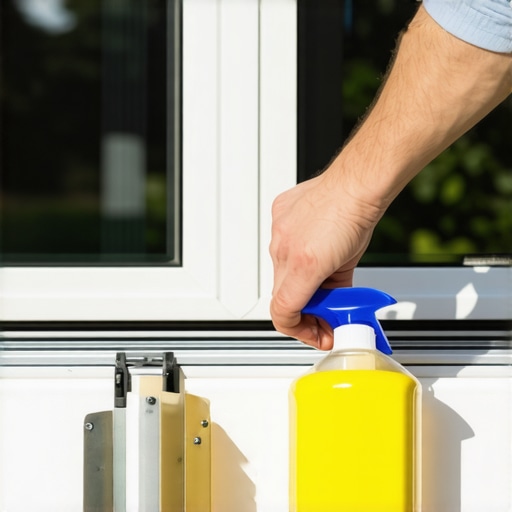
Before you reach for a lubricant, you must address the substrate. Using a standard window cleaner on the glass is only ten percent of the job. You must use a vacuum with a crevice tool to extract particulates from the track valley. If the weep hole is blocked, water will back up into the track, causing hydrostatic pressure that forces moisture into the wood subfloor. This is how the shingle principle of water management fails. Once the track is surgically clean, you must choose your lubricant with chemical precision. Never use petroleum-based products like WD-40 on vinyl or aluminum windows; these can degrade the thermoplastic elastomers in the weatherstripping or cause the vinyl to swell and discolor. Instead, use a dry silicone spray or a Teflon-based lubricant. These substances create a microscopic, low-friction layer that does not attract new dust. For historic wood windows, I still swear by a simple block of paraffin wax rubbed along the wood-on-wood contact points of the sash and the stop.
When Lubrication Isn’t Enough
Sometimes, a window that sticks is a symptom of a much larger systemic failure. If you have lubricated the tracks and the sash still requires significant force to move, the issue might be a failed balance system or a house that has settled, compressing the rough opening. If the frame is bowed, the interlock between the two sashes will not align, creating a massive air leak that destroys your energy efficiency. In these cases, you aren’t looking at a simple repair; you likely need to replace windows to restore the integrity of the building envelope.
“Installation is just as critical as the window performance itself. A high-performance window installed poorly will fail.” – AAMA Installation Masters Guide
A Technical Step-by-Step for the Operable Window
Start by raising the sash to its highest point. If it is a tilt-in model, disengage the tilt latches to expose the entire jamb track. Examine the shim placement; if a shim has slipped, it may be protruding into the track space. Clean the surface with a non-abrasive microfiber cloth and a pH-neutral solution. Once dry, apply the silicone lubricant to a clean cloth and wipe it onto the track rather than spraying it directly, which can cause overspray on the glass or the paint. Slide the sash up and down multiple times to distribute the lubricant across the constant-force balance or the block-and-tackle system. This ensures that the internal springs are also coated, preventing the metallic creak of oxidation. If the window still resists, check the muntin alignment; sometimes decorative grids can come loose and snag on the head of the frame. Water management, thermal efficiency, and mechanical longevity all depend on these small, disciplined actions.