The Mechanical Anatomy of the Sliding Threshold
In my twenty-five years of glazing, I have seen homeowners spend thousands of dollars on high-performance fenestration only to let a five-cent piece of grit destroy the entire system. A sliding glass door is not just a piece of furniture; it is a heavy-duty mechanical assembly that must manage massive structural loads while maintaining a weather-tight seal. When you operate a door that weighs 120 pounds, you are relying on precision-engineered rollers and a stainless steel or aluminum track to provide a frictionless glide. If that track is filled with dirt, pet hair, or construction debris, you are no longer sliding; you are grinding.
The Drainage Disaster: A Narrative Autopsy
I remember a specific service call in a coastal subdivision where a homeowner was convinced their frame had a manufacturing defect. They had water pooling on their hardwood floors every time a summer storm rolled through. I walked in with a simple probe and a hygrometer. I didn’t need a moisture meter to see the problem. I pulled the sliding panel out of the Rough Opening and looked at the Sill Pan. It was filled with a thick, organic sludge composed of fine sand and decayed insects. This sludge had completely plugged the Weep Hole system. In any high-quality sliding door, the track is designed to collect water that hits the glass and funnel it outside. Because the drainage path was blocked, the water had no choice but to follow the path of least resistance: over the interior dam and into the subfloor. A simple window cleaner could not have reached this; it required a full mechanical clearing. This was a textbook case where a lack of vacuuming led to a structural rot issue that eventually forced the homeowner to replace windows and doors throughout the entire rear elevation.
“Installation is just as critical as the window performance itself. A high-performance window installed poorly will fail.” – AAMA Installation Masters Guide
The Physics of Friction and Roller Fatigue
When debris accumulates in the track, it does more than just block water. It changes the physics of the door’s movement. Most modern sliding doors use tandem rollers made of nylon or stainless steel. As these rollers encounter pebbles or accumulated dust, they don’t just roll over them. The debris creates a momentary obstruction that forces the roller to skid. This skidding creates flat spots on the wheel. Once a roller has a flat spot, the smooth ‘gliding’ sensation is replaced by a rhythmic thumping. This vibration travels through the Sash and can eventually loosen the Glazing Bead or compromise the seal of the Insulated Glass Unit (IGU). In the Southern heat, where the Solar Heat Gain Coefficient (SHGC) is a constant battle, any compromise in the door’s structural integrity leads to a loss of Argon gas and a rise in energy costs. If you feel a draft, you might not need a window repair specialist; you might just need to clear the path so the door can reach its fully closed, locked position where the weatherstripping is compressed correctly.
The Thermal Logic of the Southern Climate
In hot climates, we prioritize keeping the heat out. This is why we place the Low-E coating on Surface #2 (the inner face of the outer pane). This reflects long-wave infrared radiation before it even enters the air gap. However, if your sliding door track is filthy, the door often fails to ‘seat’ properly into the side jamb. This creates a gap in the thermal envelope. No matter how high your NFRC rating is, an unseated door is a giant air leak. Dust and grit also act as an abrasive on the Flashing Tape and perimeter seals. When the sun beats down on an aluminum frame, the metal expands. If there is grit in the track during this thermal expansion, it acts like sandpaper, wearing down the protective anodized finish and inviting corrosion.
“The air leakage of a window or door shall be determined in accordance with ASTM E283. Proper maintenance of the sill and track is essential to maintaining these laboratory-certified performance levels in the field.” – ASTM E2112 Standard Practice
The Anatomy of a Proper Track Cleaning
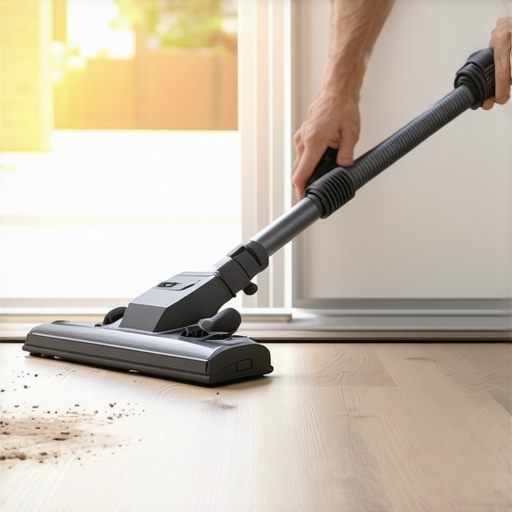
Vacuuming the track is not about aesthetics; it is about protecting the Shim and Sill Pan from premature failure. You should use a crevice tool to reach into the tight corners near the Muntin bars and the fixed panel overlap. After vacuuming, use a dry silicone spray. Never use WD-40 or oil-based lubricants, as these act as a magnet for more dust, creating a grinding paste that will accelerate the need to replace windows. Pay special attention to the Weep Hole covers. These are the small plastic flaps on the exterior of the track. If they are stuck shut with dirt, the entire pressure-equalized system fails. A glazier’s secret is to use a small burst of compressed air to ensure the internal baffles are clear of debris.