The Dangerous Dust in Your Rough Opening
I recently stood in a 1920s bungalow in the suburbs of Chicago, staring at a homeowner who was dry-scrubbing the sills of an old double-hung window. The air was thick with a fine, chalky powder. I pulled a vinyl window out of a house in that same neighborhood just a week prior and the header was completely black with rot because the previous installer relied on the nailing fin instead of proper flashing tape, but this situation was even more dire. The dust that homeowner was kicking up was not just dirt; it was concentrated lead acetate. Every time that old sash moves within its channel, it acts like a giant sandpaper block, grinding down layers of lead-based paint into a microscopic powder that settles on the sill and stool. As a master glazier with a quarter-century of experience, I see this negligence constantly. People treat their windows like simple glass, ignoring the chemical and structural realities of the frame. If your home was built before 1978, your maintenance routine is no longer just about aesthetics; it is a matter of environmental safety. To be a professional window cleaner in a historic context, you must first be a technician of containment.
The Physics of Lead Dust and Friction
Lead paint is remarkably durable, which is why it was the industry standard for decades. However, its failure mode is hazardous. When we talk about the sash, we are talking about the movable part of the window that holds the glass. In older wood windows, the sash slides against the jamb. This friction point is the primary generator of lead dust. When you go to perform window repair on these units, you are often disturbing decades of accumulated lead particles. The U-Factor of these single-pane units is abysmal, often hovering around 1.1, which means heat is pouring out of your house while lead dust is pouring into your lungs. The thermal bridge created by an uninsulated wood frame in a cold climate like Chicago or Minneapolis leads to condensation, which further degrades the paint film, making it easier for the lead to flake and peel. This is why a simple window cleaner approach is insufficient. You are dealing with a degraded substrate that requires specific chemical management. You cannot simply spray a vinegar solution and wipe it with a paper towel. That just spreads the poison.
“Installation is just as critical as the window performance itself. A high-performance window installed poorly will fail.” AAMA Installation Masters Guide
The Safe Cleaning Protocol: Wet-Wiping and HEPA Control
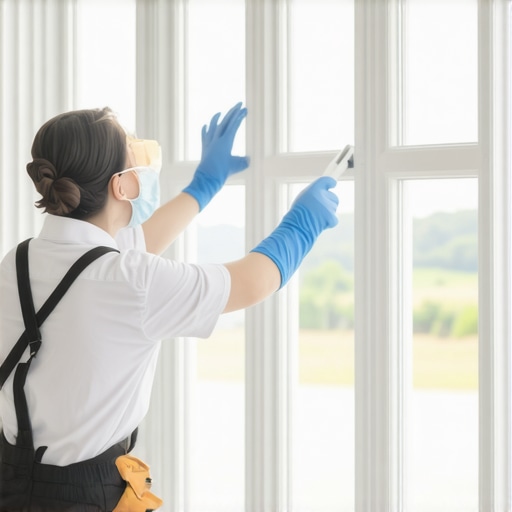
To safely manage these surfaces, you must adhere to the principle of wet-wiping. This prevents lead particles from becoming airborne. Start by donning a N100 rated respirator; a standard surgical mask is useless against lead dust. You will need a specialized detergent, often one containing trisodium phosphate or a dedicated lead-leaching soap, to break the ionic bond the lead has with the wood surface. Do not use a vacuum unless it is a certified HEPA vacuum with a sealed bypass. Standard shop-vacs will simply suck up the lead dust and exhaust it back into the room through the filter. When cleaning the glass, ensure your squeegee does not catch on the glazing bead. The glazing bead is the strip of wood or putty that holds the glass in the sash. If this is painted with lead-based paint and it is brittle, the pressure of a squeegee can snap off shards of paint. Focus your cleaning on the stool and the sill pan area. This is where the highest concentration of dust accumulates. Use disposable cloths and a two-bucket system: one for the soapy solution and one for clean rinse water. This prevents cross-contamination of your cleaning solution.
The Technical Reality of Window Repair vs. Replacement
Many homeowners ask if they should pursue window repair or simply replace windows entirely when lead is present. From a technical standpoint, repairing a lead-painted sash to a point of safety is often more expensive than a full-frame replacement. To truly mitigate the lead, you have to strip the sash to bare wood, which involves specialized infrared heaters or chemical strippers that do not vaporize the lead. If you are in a Northern climate, the ROI on keeping those old sashes is non-existent. A modern window with a Low-E coating on surface number 3 will reflect long-wave infrared radiation back into your home, significantly reducing your heating load. In contrast, your old wood sashes are likely leaking air at a rate that makes your furnace work double time. When we look at the rough opening of an old window, we often find that the weight pockets are uninsulated voids that act as chimneys for cold air. Replacing these with modern, high-performance units allows us to seal those pockets and install a proper sill pan to manage water egress.
“Standard practice for the installation of exterior windows, doors and skylights requires a continuous air barrier and integrated flashing to prevent moisture-induced degradation of the building envelope.” ASTM E2112
Understanding the NFRC Ratings for Your Replacement
If you decide to replace windows to eliminate the lead hazard, you must understand the labels. In the North, the U-Factor is your most critical metric. You want a U-Factor of 0.27 or lower. This measures the rate of non-solar heat loss. The lower the number, the better the window is at keeping the heat you paid for inside your house. We achieve these numbers using multiple panes of glass with an Argon gas fill. The gas is denser than air and slows down the convection currents between the panes. Furthermore, the use of warm-edge spacers, rather than traditional aluminum spacers, prevents the edge of the glass from getting cold enough to reach the dew point. This eliminates the condensation that usually triggers the paint peeling on older lead-painted frames. You should also look at the Visible Transmittance (VT). While you want to block heat loss, you still want the natural light that makes a space livable. A high-quality Low-E coating is engineered to be selective, allowing visible light through while blocking the ultraviolet and infrared spectrums that fade furniture and transfer heat.
Conclusion: The Glazier’s Final Word on Safety
Managing lead paint is not about fear; it is about respecting the chemistry of your home. If you choose to remain a diligent window cleaner for your historic sashes, you must adopt the technical rigor of an abatement professional. However, if the structural integrity of the sash is compromised, or if the lead hazard is too prevalent, the only scientific solution is to replace windows with modern, inert materials like fiberglass or high-quality vinyl. Fiberglass is particularly effective because it has the same thermal expansion coefficient as glass, meaning the seals stay tight for decades, unlike wood which swells and shrinks, constantly cracking any paint you apply. Whether you repair or replace, remember that the rough opening is the most vulnerable part of your wall. Treat it with the technical precision it requires. No amount of caulk can fix a fundamental failure in water management or lead safety. Use the right tools, follow the physics, and protect your living environment from the legacy of lead paint dust. [HowTo: {“@context”: “https://schema.org”, “@type”: “HowTo”, “name”: “How to Safely Clean Lead Paint Windows”, “step”: [{“@type”: “HowToStep”, “text”: “Wear a N100 respirator and disposable gloves.”}, {“@type”: “HowToStep”, “text”: “Use a wet-wiping technique with a TSP-based cleaner to avoid airborne dust.”}, {“@type”: “HowToStep”, “text”: “Clean the window stool and sill pan using disposable cloths.”}, {“@type”: “HowToStep”, “text”: “Dispose of all cleaning materials as hazardous waste according to local regulations.”}]}]