Beyond the Windex: The Professional Glazier’s Perspective
In twenty-five years of handling everything from heavy-duty commercial curtain walls to delicate residential sash restorations, I have learned that most homeowners approach window maintenance from a fundamentally flawed perspective. They see a smudge and reach for a spray bottle and a paper towel. To a master glazier, that is the equivalent of trying to clear a muddy windshield with sandpaper. You are not cleaning the glass; you are merely rearranging the particulate matter and static-loading the surface. The real secret to a crystalline finish does not come from a proprietary chemical formula found in a spray bottle. It comes from understanding the fluid dynamics of a professional squeegee and the physics of the glass surface itself.
A window is a porous, high-energy surface that attracts contaminants through ionic bonds. When we talk about a window cleaner or a professional window repair, we are talking about maintaining the integrity of the Insulated Glass Unit (IGU). If you are looking to replace windows because they look perpetually ‘dirty,’ you might be misdiagnosing a structural failure for a maintenance issue. But if the glass is sound, the tool that will save your sanity costs about a dollar in raw rubber: the squeegee blade.
“Installation is just as critical as the window performance itself. A high-performance window installed poorly will fail.” – AAMA Installation Masters Guide
The Condensation Crisis: A Narrative of Failed Physics
A homeowner in Minneapolis once called me in a panic because their expensive new windows were ‘sweating’ and ‘streaky’ no matter how much they cleaned them. I walked into the home with my hygrometer and observed the readings. I showed them that the interior humidity was hovering at sixty percent while the outside temperature was dropping toward zero. It was not a failure of the glass or the window cleaner; it was a failure of the home’s microclimate. I had to explain that their lifestyle, involving a lack of ventilation and a high-moisture basement, was forcing the dew point to manifest right on the surface #4 of their glazing. This is the ‘Condensation Crisis.’ People often think they need a window repair when they actually need a dehumidifier and a better understanding of how the U-Factor affects their glass surface temperature.
The Glazing Zoom: The Physics of the $1 Squeegee Technique
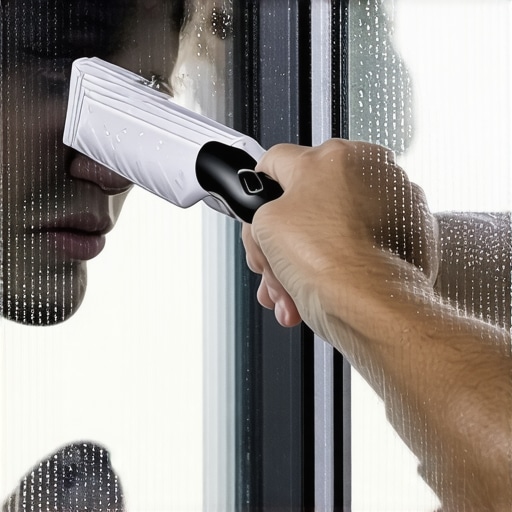
To achieve a streak-free finish, you must master the ‘Fanning’ or ‘S-Curve’ technique. This is not just about moving water; it is about managing the surfactant’s surface tension. When you use a professional-grade squeegee, you are using a sharp rubber edge to shear the water and suspended solids away from the glass. The secret is the ‘cut-in.’ You start by wiping a dry perimeter around the top and one side of the sash with a microfiber cloth. This prevents ‘picture framing,’ where water seeps back from the glazing bead or the muntin onto the clean pane. Then, you place the squeegee at a seven-degree angle. By pivoting the handle, you create a continuous downward flow that never leaves the glass. This ensures that the dirty solution is moved into the center of the stroke and eventually off the bottom of the pane. If you lift the blade, you leave a line. If you leave a line, you have failed.
Why Your Window Cleaner is Probably Making Things Worse
Most consumer-grade window cleaners contain detergents that leave a microscopic film. This film is ‘tacky,’ meaning it attracts dust and pollen the moment the sun hits it. A professional mix is usually nothing more than a few drops of dish soap in a gallon of distilled water. The soap acts as a lubricant (surfactant) to allow the squeegee to glide without ‘chattering.’ Chattering is the enemy of the glazier; it indicates that the rubber is jumping over the glass, leaving behind microscopic deposits that will later manifest as streaks. When you are looking to replace windows, look for glass with a titanium dioxide coating. These are often marketed as ‘self-cleaning’ because they use UV light to break down organic dirt and allow water to sheet off, rather than bead up. This is the difference between a hydrophobic and a hydrophilic surface.
“The thermal performance of a fenestration system is only as good as its weakest link, often the spacer or the secondary seal.” – NFRC Technical Bulletin
Window Repair vs. Total Replacement: The Brutal Truth
When I am called out for a window repair, the first thing I check is the integrity of the desiccant inside the spacer bar. If you see ‘fogging’ or ‘streaks’ that you cannot reach with a squeegee, your seal has failed. This is the ‘Solar Pumping’ effect. Every day, the sun heats the air between the panes, causing it to expand and put pressure on the primary polyisobutylene seal. At night, it cools and contracts. Eventually, the seal develops a microscopic breach. Moist air is sucked in, and the desiccant beads inside the spacer become saturated. Once those beads are full, the moisture has nowhere to go but onto the glass. At this point, no amount of cleaning will help. You are looking at an IGU replacement or a full-frame tear-out.
The Anatomy of the Rough Opening
If you decide to replace windows, do not fall for the ‘caulk-and-walk’ installers who simply shim a new frame into an old, rotting rough opening. I have seen countless installations where the installer relied on the nailing fin and a bead of cheap silicone. A proper installation requires a sill pan with a rear dam to ensure that any water that gets past the primary seal is directed back out through the weep holes. If your installer doesn’t mention the ‘Shingle Principle’ (lapping flashing tape so that the upper layer always covers the lower layer), you should show them the door. A window is a hole in your thermal envelope; if it is not managed with proper head flashing and drip caps, that hole will eventually rot your studs.
The Thermal Logic of Your Climate
In colder northern climates, we prioritize the U-Factor. We want a Low-E coating on surface #3 to reflect the long-wave infrared heat back into the room. If you are cleaning windows in the winter and they feel ice-cold to the touch, you are losing money every second. We use argon or krypton gas fills because they are denser than air and slow down the convective currents between the panes. When we talk about the ‘Secret Squeegee Technique,’ we are also talking about inspecting the glazing bead and the sash for any signs of air infiltration. A streak-free window is useless if it is letting a draft through the shim space because someone forgot to use low-expansion foam. Do not buy the marketing hype; buy the NFRC numbers. A U-Factor of 0.27 or lower is what you should be aiming for in a heating-dominated climate.
The Final Word on Maintenance
Stop treating your windows like an afterthought. The $1 squeegee technique is about more than just aesthetics; it is about the long-term health of your home’s fenestration. By using a squeegee instead of abrasive cloths, you preserve the specialized coatings on the glass. You avoid clogging the weep holes with paper towel lint. And most importantly, you get close enough to the window to notice the small things: a cracked glazing bead, a failing shim, or a bit of rot in the sill. That is the difference between a homeowner and a true steward of their property. Follow the physics, respect the seal, and keep your rubber blades sharp.