The Diagnostic Tool You Didn’t Expect
In my twenty five years as a master glazier, I have seen every possible failure of the building envelope, but one of the most consistent indicators of impending window doom isn’t found in a thermal camera or a moisture meter. It is found in the toolkit of a high end window cleaner. Specifically, it is the small squeegee, usually no more than six inches wide, that tells the real story of a home’s health. While most homeowners view a squeegee as a tool for visibility, for a professional, it is a precision instrument used to navigate the tight tolerances of a Glazing Bead and to inspect the integrity of the Sash.
The Narrative of the Fogged Pane
I recall a specific instance that perfectly illustrates the intersection of maintenance and window repair. A homeowner called me in a panic because their new windows were ‘sweating’ and the professional cleaner they hired couldn’t get them clear. I walked in with my hygrometer and showed them the humidity was 60 percent. It wasn’t the windows; it was their lifestyle. They had a massive collection of tropical plants and a humidifier running at full blast. That small squeegee the cleaner was using was the first thing to hit the glass, and when it failed to remove the ‘dirt’ on the inside of the unit, we knew exactly what we were looking at: interstitial condensation. The seals had failed, but the root cause was the excessive interior moisture putting constant pressure on the desiccant inside the spacer bar. This is where the physics of the Rough Opening and the thermal break come into play. When a window is installed, we often focus on the Shim and the Flashing Tape, but we forget that the glass itself is a living part of the wall that reacts to the environment.
“Installation is just as critical as the window performance itself. A high-performance window installed poorly will fail.” AAMA Installation Masters Guide
The Physics of the Small Squeegee
Why a small one? Because the edges of a window are where the secrets are kept. A large squeegee is for the center of the lite, but the six inch blade is designed to run along the Glazing Bead. This is the plastic or wood strip that holds the glass in the frame. If a window cleaner notices water bypassing this bead, they are seeing the first sign of a seal failure. In cold climates like Chicago or Minneapolis, heat loss is the primary enemy. We track this through the U-Factor, which measures the rate of non solar heat loss. The lower the U-Factor, the better the window is at keeping heat inside. When a professional uses that small squeegee, they are often clearing away the frost that forms on the edge of the glass because of a ‘cold-edge’ spacer. Modern windows utilize warm-edge spacers to prevent this, but older units with aluminum spacers create a thermal bridge that pulls heat right out of the room. This is why we recommend Low-E coatings on Surface #3 in northern climates. This coating reflects long-wave infrared radiation, also known as heat, back into the house during the winter months. If that surface is dirty or etched by mineral deposits, its efficiency drops. The squeegee is the tool that maintains the thermal integrity of that coating.
When to Repair and When to Replace Windows
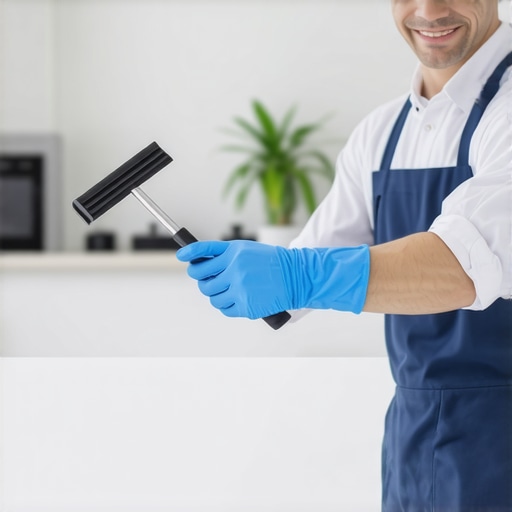
Every homeowner asks the same question: can I just do a window repair, or do I need to replace windows entirely? The answer is often hidden in the Sill Pan. If you see water standing in the track of an Operable window, your Weep Hole system might be clogged. Professional cleaners use their small squeegee to push water toward these holes to ensure they are functional. If the water doesn’t drain, it backs up into the Rough Opening, leading to the kind of rot that destroys headers and jack studs. [IMAGE_PLACEHOLDER] I have seen cases where the Flashing Tape was perfectly applied, but because the weep holes were blocked by debris or poor paint jobs, the water had nowhere to go but into the wood framing. This is why the ‘caulk and walk’ installers are so dangerous. They fill the gaps that were meant to breathe, trapping moisture against the wood. If you see black mold on your drywall near the window, the time for a simple cleaner has passed. You are looking at a full frame tear out because the Sill Pan was either never installed or was compromised by a Shim driven too deep through the flashing.
“The National Fenestration Rating Council (NFRC) provides consistent ratings on window, door, and skylight energy performance, helping consumers compare products.” NFRC Performance Standards
The Science of Glass Coatings
Let’s talk about Glazing Zooming. Most people see glass as a solid, but it is effectively a molecular sieve. In cold climates, the goal is to manage the dew point. The dew point is the temperature at which air can no longer hold its water vapor, causing it to condense into liquid. If the interior surface of your glass is cold enough to hit the dew point of your indoor air, you get condensation. This is why triple-pane units with Argon gas fills are so effective in the North. Argon is denser than air and significantly slows the convective loop within the Insulated Glass Unit (IGU). When a cleaner uses a squeegee, they are removing the microscopic particulates that can provide nucleation points for ice crystals. By keeping the glass surface perfectly smooth, you actually reduce the surface area available for frost to grip. Furthermore, the Muntin or Grille on a window isn’t just for looks; if it is an external grille, it creates a series of small pockets that can trap cold air. A skilled cleaner knows that these corners are the first place where the Glazing Bead will fail. If you are going to replace windows, consider ‘Between the Glass’ grilles to eliminate these thermal and maintenance traps. In the end, that small squeegee is more than a cleaning tool; it is a barometer for the structural and thermal health of your home’s most vulnerable points.