The Science of Surface Tension: Why Your Windows Attract Dust
In my twenty-five years as a master glazier, I have seen every possible failure in the fenestration industry, from catastrophic seal failure to frames that warp like wet cardboard. But the most common complaint I hear from homeowners is not about the U-factor or the Solar Heat Gain Coefficient (SHGC); it is about the simple, relentless accumulation of dust. To a window professional, glass is not a solid, static barrier. It is an amorphous solid with a microscopic surface topography that acts as a magnet for airborne particulates. Most people clean their windows using high-alkaline sprays that leave a sticky residue, which creates a high-friction surface where dust can easily anchor itself. If you want to stop cleaning your windows every Saturday, you have to understand the physics of the glass surface and the chemistry of the liquids you apply to it.
“The selection of window cleaning agents and methods must be consistent with the preservation of the glass surface and the surrounding glazing materials. Improper cleaning can lead to permanent damage of the glass surface or the failure of the glazing seals.” – AAMA Cleaning and Maintenance Guide
A homeowner called me in a panic because their new windows were ‘sweating.’ I walked in with my hygrometer and showed them the humidity was 60 percent. It was not the windows; it was their lifestyle, combined with a layer of grime that was holding moisture against the glass. This moisture-dust slurry eventually etches the glass. When you live in a hot, dry climate like the South or Southwest, the sun bakes these particles into the glass, especially on Surface #1 (the exterior face). The heat increases the molecular activity on the surface, making it more reactive to pollutants. To fight this, you do not need an expensive industrial chemical. You need a $1 solution that alters the surface energy of the pane.
The $1 Anti-Static Formula: Chemistry Over Marketing
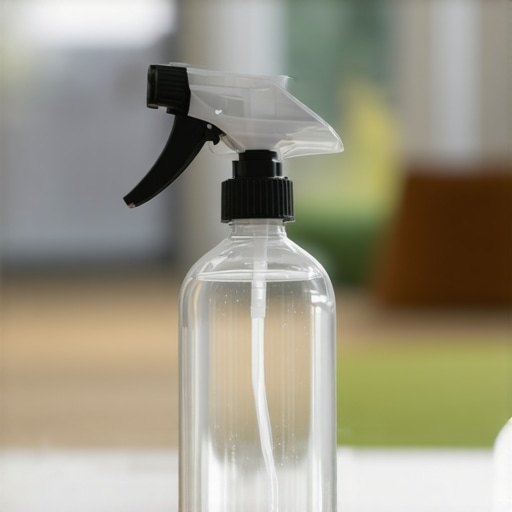
The solution involves three simple components: distilled water, white vinegar, and a surfactant. The distilled water is non-negotiable. Tap water contains minerals like calcium and magnesium that create ‘seeds’ for dust to bond to. The white vinegar (acetic acid) acts as a mild solvent to break down organic oils. The secret is the surfactant, typically a single drop of high-quality liquid dish soap. This surfactant reduces the surface tension of the water, allowing it to spread into an incredibly thin, uniform layer that carries away contaminants without leaving a film. For those in high-dust environments, adding a small amount of cornstarch—about a teaspoon—is a trick we use in the trade to fill the microscopic voids in the glass, creating a smoother surface that prevents static electricity from grabbing dust out of the air. This is the difference between a ‘caulk-and-walk’ mentality and true window maintenance.
Understanding Your Windows: Repair vs. Replace
When I am inspecting an operable sash, I often find that what the homeowner thinks is dirt is actually internal fogging. If you see streaks or a ‘milky’ appearance that you cannot scrub off, the IGU (Insulated Glass Unit) has suffered a seal failure. This means the Argon or Krypton gas fill has leaked out and been replaced by moisture-laden air. No spray bottle mix will fix a blown seal. In these cases, you are looking at a window repair where the glass unit itself is replaced, or if the frame is degraded, you must replace windows entirely. For homes in the South, where the SHGC is critical, a failed seal also means your Low-E coating on Surface #2 is likely oxidizing, losing its ability to reflect radiant heat. This sends your cooling costs through the roof because the window is no longer a thermal barrier but a heat conductor.
The Anatomy of a Professional Clean: Weep Holes and Glazing Beads
A window is an integrated system. When you use your $1 spray mix, you must also inspect the weep holes in the bottom of the frame. These are designed to allow water to exit the sill pan. If these are clogged with dirt and debris, water will back up and rot the rough opening or damage the shims holding the window level. I always tell my apprentices that a window is only as good as its drainage. While cleaning, check the glazing bead—the plastic or wood strip that holds the glass in the sash. If this is loose or cracked, dust and moisture will infiltrate the internal cavity of the window, leading to mold and structural decay. Proper maintenance requires more than just a wipe-down; it requires a technical eye on the hardware and the weatherstripping.
“The performance of a fenestration product is dependent on the integrity of the seal and the cleanliness of the thermal barriers. Accumulation of debris in the track system can compromise the air infiltration ratings of the entire unit.” – NFRC Technical Manual
The Physics of Light and Heat in Your Climate
In hot climates, the goal is to keep the sun’s energy out. If your windows are dirty, they actually absorb more heat, increasing the thermal stress on the glass. This can lead to stress cracks, especially in large, fixed-lite windows. By keeping the glass clean with an anti-static mix, you ensure that your Low-E coatings can perform as designed. These coatings are engineered at the Angstrom level to reflect long-wave infrared radiation. When dust covers the surface, it interferes with this reflection, effectively turning your high-performance window into a piece of standard clear glass. This is why a window cleaner’s job is actually a form of energy auditing. You are restoring the thermal efficiency of the home with every spray of the bottle.
Final Thoughts from the Glazing Bench
Do not be fooled by high-pressure sales tactics claiming you need new windows when a thorough cleaning and minor window repair could suffice. However, if your frames are drafty or the wood is soft to the touch, no amount of vinegar and water will save you. When you do choose to replace windows, ensure your installer uses proper flashing tape and a high-quality sill pan. A window is a hole in your wall, and my job is to make sure that hole remains a controlled environment. Use the $1 mix, keep your weep holes clear, and respect the physics of your home’s envelope. Glass is a beautiful, complex material that deserves more than a squirt of blue dye and a paper towel.