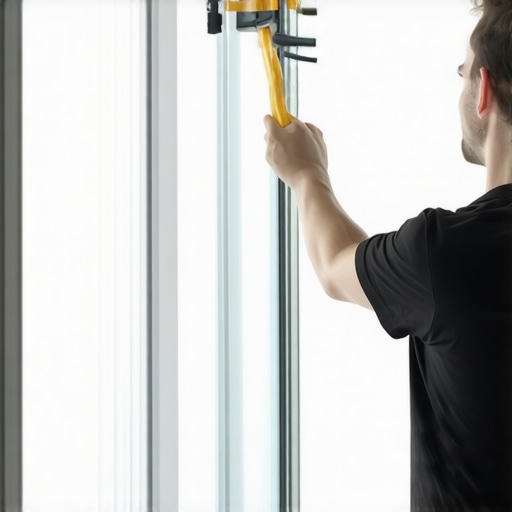
Beyond the Surface: The Physics of the 45-Degree Squeegee Angle
In the world of professional glazing, we don’t just look at a window as a piece of glass; we see a sophisticated thermal envelope. When you see a professional window cleaner tilt their squeegee at a 45-degree angle, they aren’t performing a stylistic flourish. They are managing fluid dynamics and surface tension. As a glazier with over 25 years in the field, I’ve seen how proper maintenance—or the lack thereof—can dictate the lifespan of an Insulated Glass Unit (IGU). The 45-degree angle is critical because it creates a ‘leading edge’ that directs the dirty solution away from the top of the sash and toward the uncleaned portion of the pane. This prevents the ‘fanning’ effect where dirty water seeps back under the blade, leaving those maddening streaks that DIYers struggle with. By maintaining this specific angle, the cleaner ensures that the meniscus—the curve of the liquid—is consistently broken and moved in a single direction, rather than being compressed against the glazing bead where it can stagnate and cause issues.
The Condensation Crisis: A Master Glazier’s Narrative
A homeowner called me in a panic last November because their new windows were ‘sweating’ and they were convinced the seals had failed within six months. I walked into the house with my hygrometer and a high-intensity inspection light. I didn’t find a window repair problem in the traditional sense; I found a lifestyle mismatch. I showed the homeowner that their indoor humidity was hovering at 60%, while it was 20 degrees outside. It wasn’t the windows failing; it was their indoor climate management. They were blaming the U-factor of the glass when the reality was a lack of ventilation. I used a squeegee to clear the condensation and showed them that the glass was perfectly clear once the surface moisture was managed. This is a common misconception in the industry. People often think they need to replace windows when they actually need to manage their dew point. If the interior surface temperature of the glass falls below the dew point of the air in the room, you get liquid water. That water then runs down the sash, sits in the sill pan, and if your weep holes are clogged with debris because you haven’t been cleaning them properly, you end up with rot in your rough opening.
“Installation is just as critical as the window performance itself. A high-performance window installed poorly will fail.” – AAMA Installation Masters Guide
The Science of the Glass: Low-E Coatings and Maintenance
When we talk about window repair or the decision to replace windows, we have to discuss the coating science. Most modern high-performance windows utilize Low-Emissivity (Low-E) coatings. In our northern, colder climates, we typically see these on Surface #3—the inward-facing side of the outboard pane or the outward-facing side of the inboard pane. This coating is a microscopically thin layer of silver or other low-emissive materials that reflects long-wave infrared radiation. Professional cleaners use a 45-degree squeegee angle to ensure they are using the least amount of pressure possible. Why? Because even though the coating is often protected inside the IGU, the exterior surfaces (Surface #1 and #4) often have ‘easy-clean’ hydrophilic coatings. If you use a ‘caulk-and-walk’ installer’s approach to cleaning—using abrasive pads or harsh chemicals—you can actually strip these coatings or create microscopic scratches that attract more dirt over time. A professional window cleaner knows that the rubber blade must glide on a thin film of solution, and the 45-degree angle optimizes the ‘hydroplaning’ effect of the blade over these high-tech surfaces.
Anatomy of the Frame: Why Cleaning Leads to Better Repairs
Every time you clean a window, you are performing a mini-inspection. This is where you notice if the glazing bead is starting to pull away or if the muntins are becoming loose. A professional glazier looks for the health of the weep holes. These are the small valves at the bottom of the frame that allow water to exit the track. If a window cleaner isn’t thorough, or if they don’t use the correct squeegee technique, they can actually push more dirt into these weep holes, leading to internal frame saturation. In my years of experience, the biggest cause of premature window failure isn’t the glass itself, but the failure of the flashing tape and the sill pan. When water can’t escape through the weep hole because it’s clogged with silt, it finds the path of least resistance—usually into your wall cavity. This is why I tell people that regular maintenance isn’t just about the view; it’s about protecting the structural integrity of the rough opening. A properly shimmed window should have enough clearance for the frame to expand and contract without compromising the seal, but if that gap is filled with moisture and dirt, the shims can rot and the frame can sag, leading to an inoperable sash.
“The NFRC label provides the only reliable way to compare the energy performance of windows, doors, and skylights.” – NFRC Performance Guidelines
U-Factor, SHGC, and the Thermal Envelope
In cold climates, the U-factor is our primary metric. It measures the rate of non-solar heat loss. When you are cleaning your windows and you feel a ‘draft,’ it’s often not air leakage but a ‘convective loop’ caused by the cold glass surface cooling the air inside the room, which then drops and creates a breeze. This is why we push for triple-pane units with argon or krypton gas fills. The gas is denser than air and slows down the thermal transfer. However, if the seal on your IGU fails, the gas escapes and is replaced by moisture-laden air. This is when you see the internal fogging that no squeegee can fix. At that point, window repair is no longer an option; you are looking to replace windows. When selecting replacements, you need to look for warm-edge spacers—the material that separates the panes of glass. Older aluminum spacers acted as a thermal bridge, conducting cold directly to the edge of the glass, which is where condensation starts. Modern composite spacers keep the edge of the glass warmer, significantly reducing the risk of mold growth on the sash.
The Professional’s Tool: Squeegee Mechanics vs. Standard Cleaning
The technical reason the 45-degree angle works involves the interaction between the rubber shore hardness and the glass surface. A squeegee blade is not perfectly flat; it has a sharp edge that must stay in constant contact with the glass. When you pull it straight down, the friction is uniform across the whole blade, which can lead to ‘chatter’—the blade jumping across the glass and leaving streaks. By angling the tool, you reduce the surface area of the blade in direct resistance to the direction of travel, allowing for a smoother, more consistent glide. This is the same principle we use when we shim a heavy glass door or set a large storefront pane. You want to manage the forces of gravity and friction rather than fighting them. If you are a homeowner considering window repair, start by observing how your windows handle water. If the water doesn’t bead and roll toward the weep holes, or if the squeegee leaves a film despite using a professional-grade solution, your glass may be etched from hard water or the sealants may be leaching oils onto the surface, which is a sign of a failing glazing bead or degraded flashing tape.
Conclusion: The Installer Matters More Than the Sticker
Ultimately, whether you are hiring a window cleaner or a crew to replace windows, the technical details matter. You can buy the most expensive triple-pane, Low-E, krypton-filled window on the market, but if it isn’t installed with a proper sill pan, high-quality flashing tape, and precise shimming within the rough opening, it will fail. The 45-degree squeegee angle is a metaphor for professional glazing: it’s about doing the technical things correctly to ensure long-term performance. Don’t be swayed by high-pressure sales pitches about energy savings that will take 50 years to pay back. Focus on the quality of the installation, the durability of the frame materials—fiberglass is my personal favorite for stability—and a consistent maintenance schedule. A clean window is a window you can inspect, and an inspected window is one that will protect your home for decades.