The Chemistry of the Cloud: Why Your Windows Look Dirty After Cleaning
As a master glazier with over two and a half decades in the field, I have seen every possible failure of the building envelope, but few things frustrate a homeowner more than a persistent, cloudy haze on their glazing that refuses to budge. Most people reach for a standard window cleaner and a paper towel, only to find that the white spots remain as stubborn as a rusted-out sash weight. To understand how to fix this, you have to understand the material science of the glass itself. Glass is not the perfectly smooth, impervious surface it appears to be. Under a microscope, it is a landscape of peaks and valleys, a porous medium that is surprisingly reactive to its environment. When magnesium and calcium from hard water sit on that surface, they don’t just sit there; they bond. Over time, heat from the sun facilitates a chemical reaction that can lead to stage two corrosion, where the minerals actually etch into the silica structure. This is no longer a cleaning job; it is a glass restoration or window repair project.
“Installation is just as critical as the window performance itself. A high-performance window installed poorly will fail.” AAMA Installation Masters Guide
A homeowner called me in a panic because their new windows were ‘sweating’ and developed heavy white scaling within months of a high-end installation. I walked in with my hygrometer and a moisture meter, and the readings were off the charts. It turned out they had a decorative fountain splashing directly onto the glass, and the sun was baking those minerals into the surface at high temperatures. I had to explain that it wasn’t a manufacturing defect in the glazing; it was a maintenance and lifestyle issue that was actively destroying their investment. If left untreated, those stains would have permanently compromised the visible transmittance of the units, necessitating an expensive replace windows scenario far ahead of the actual life cycle of the frames.
The Citric Acid Solution: Why an Old Lemon Works
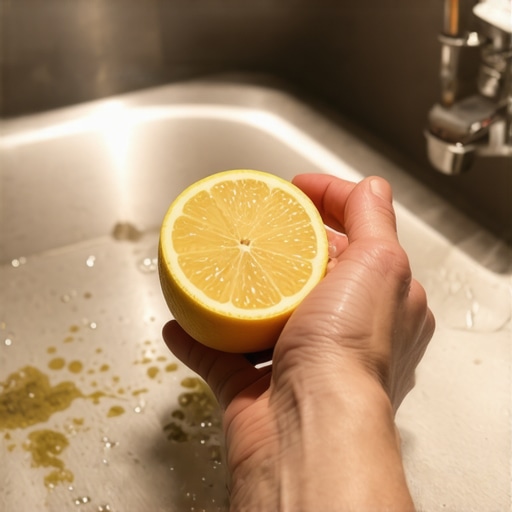
When we talk about the physics of mineral removal, we are looking for a way to break the ionic bond between the calcium carbonate and the glass. This is where the humble lemon comes in. Citric acid is a natural chelating agent. When you apply the juice of an old lemon to a hard water stain, the acid reacts with the alkaline mineral deposits, converting them into a water-soluble form that can be wiped away without the need for abrasive scrubbing that could scratch the glass or damage delicate Low-E coatings. To do this correctly, you must first clear any debris from the Rough Opening and ensure the Sill Pan is clear of grit. Cut the lemon and rub it directly over the calcified area, letting the juice sit for several minutes. Do not let it dry, as the goal is to keep the minerals in suspension. Use a microfiber cloth to gently agitate the area, then rinse with distilled water. Distilled water is key because it lacks the minerals that caused the problem in the first place.
Understanding the Surface: Low-E and Thermal Performance
In modern window construction, we deal with sophisticated metallic layers known as Low-E coatings. If you are dealing with hard water stains on the interior surface of a window, you must be extremely cautious. On most dual-pane units, the coating is on Surface #2 or Surface #3, safely tucked inside the Argon-filled space between the panes. However, some high-performance units feature a hard-coat Low-E on Surface #4 (the interior face). Using harsh chemicals or abrasive pads on this surface can strip the coating, permanently ruining the U-Factor of the window. When I evaluate a window repair, I always check the NFRC label to see exactly what kind of glass package we are dealing with. If you have a high Solar Heat Gain Coefficient (SHGC), that glass is designed to let in a lot of energy, which means it gets hotter, which in turn means mineral stains will bake on much faster. In southern climates, where we want a low SHGC, the Low-E coating is typically on Surface #2 to reflect infrared radiation before it even enters the home.
“The NFRC provides a fair, accurate, and credible rating system for the energy performance of windows, doors, and skylights.” NFRC Performance Standards Manual
If the stains have progressed to the point where the glass feels rough to the touch even after a citric acid treatment, the glass is likely etched. At this point, the structural integrity of the glazing isn’t compromised, but the aesthetic and functional clarity is. You might be looking at an IGU (Insulated Glass Unit) replacement. This involves removing the Glazing Bead, pulling out the sealed unit, and installing a new one within the existing Sash. It is a far more cost-effective window repair than a full-frame replacement, provided your frames are still in good condition. During this process, I always check the Weep Hole system. If water is backing up in the frame, it increases the local humidity and accelerates the deposition of minerals on the glass edges, often leading to seal failure.
When Maintenance Becomes Replacement: Evaluating the Frame
While cleaning your glass, take the opportunity to inspect the overall health of the window system. Check the Shim spacing and the condition of the Flashing Tape around the perimeter. If you see signs of daylight around the Rough Opening or if the Operable parts of the window are sticking, the hard water stains might be the least of your problems. A window that is out of square will put uneven pressure on the glass, making it more prone to stress cracks and seal failure. If you are constantly battling moisture and stains, and your windows are more than 20 years old, it may be time to replace windows with modern fiberglass or thermally broken aluminum units. Modern units offer vastly superior thermal breaks, which keep the interior glass surface warmer in winter and cooler in summer, significantly reducing the condensation that allows minerals to gain a foothold. Remember, a window is a complex system designed to manage the flow of energy and water. Treating it like a simple piece of glass is a recipe for long-term structural issues. Proper maintenance with natural acids is a great first step, but always be ready to call in a professional if you suspect the damage goes deeper than the surface.